

Legal clients don't always start their search by scrolling through ten blue links anymore. Increasingly, they ask an AI platform something like "Who's a good divorce attorney in my area?" or "What should I look for in a personal injury lawyer?" and get a synthesized answer, often with two or three firms named directly. If your firm isn't one of them, you've lost the client before they ever reached your website a dynamic closely tied to the broader shift toward zero-click search results, where the answer satisfies the searcher without a single click ever happening.
Table of Contents
That shift is exactly what Generative Engine Optimization exists to address, and it's a big part of why law firm SEO services now need to account for AI-generated answers, not just traditional rankings.
What Is GEO for Law Firms?
Generative Engine Optimization (GEO) is the practice of structuring a law firm's website and content so AI systems ChatGPT, Gemini, Perplexity, and Google's AI Overviews can accurately extract, verify, and cite it when answering a user's question.
It sits alongside two related disciplines: SEO, which governs whether your pages get crawled, indexed, and ranked at all, and AEO (Answer Engine Optimization), which focuses on earning the direct quote inside a generated answer box. GEO is the broader umbrella: a firm that ignores structured data and schema markup is handing AI models less confidence to work with, which makes citation far less likely.
The core difference from traditional SEO is what these systems are actually evaluating. A search engine ranks pages. A generative engine evaluates entities: is this a real, credentialed attorney, in the jurisdiction the user asked about, with content clear enough to summarize accurately? That's a fundamentally different set of signals, and it's part of why questions about whether SEO is still relevant keep coming up in legal marketing conversations, even though the honest answer is that SEO fundamentals remain the foundation GEO is built on top of.
Why GEO Matters for Law Firms Right Now
AI-generated answers are appearing across a growing share of legal search queries, and industry reporting has consistently pointed to AI Overviews and chat-based answers citing more sources per response than they did even a year or two ago. What that means practically: there are more citation slots available, but also more competition for each one, since AI systems are pulling from a wider pool of sources to build a single answer.
For law firms specifically, that raises the stakes. Legal decisions are high-trust, high-stakes choices; people don't hire an attorney on a whim, which means AI systems lean even harder on credibility signals like verified credentials, clear practice areas, and jurisdiction-specific detail before citing a firm at all.
Building a GEO Strategy for Your Firm
A working GEO strategy for a law firm generally rests on a few pillars:
Entity clarity.
Attorney bios, bar admissions, practice areas, and jurisdictions need to be unambiguous and consistent across the site, not just present, but structured in a way a machine can parse.
Structured data and schema.
Implementing LegalService, Person, and FAQPage schema gives AI systems explicit, machine-readable context instead of forcing them to infer it from prose.
Content built to be extracted.
Headings phrased as real questions ("What Does a Personal Injury Case Cost?") perform better than vague labels like "Overview," because they mirror how people actually phrase questions to AI systems.
Technical foundations.
None of this matters if a crawler can't reach the page in the first place. Fast load times and clean site architecture remain the base layer; everything else depends on a large language model optimization strategy that still starts with a technically sound site, not a workaround for a broken one.
Local and practice-area specificity.
A firm that clearly signals "family law attorney in [city]" gives AI systems a far easier match to a localized query than generic, unspecific language, which is part of why local search visibility work and GEO increasingly overlap rather than operate as separate tracks.
Common GEO Mistakes Law Firms Make
- Generic content that just restates definitions. AI systems rarely cite a page that says nothing a hundred other pages don't already say.
- Thin attorney bios. Missing credentials, awards, or case history weakens the trust signal an AI model needs before naming your firm by name.
- Skipping schema entirely. Without it, AI systems are left guessing at what your practice areas and jurisdiction actually are.
- Treating GEO as a one-time setup. AI platforms recrawl and re-evaluate constantly; a strategy needs ongoing content and technical upkeep, not a single audit.
How Auxilium Technology Approaches GEO for Law Firms
Auxilium Technology builds GEO strategy on top of the same technical and content foundation that's always driven strong SEO results: clean site architecture, credentialed attorney content, and schema that gives AI systems what they need to cite a firm confidently. For law firms specifically, that work is paired with the industry knowledge built into professionally produced legal content, so pages read as genuinely authoritative rather than templated.
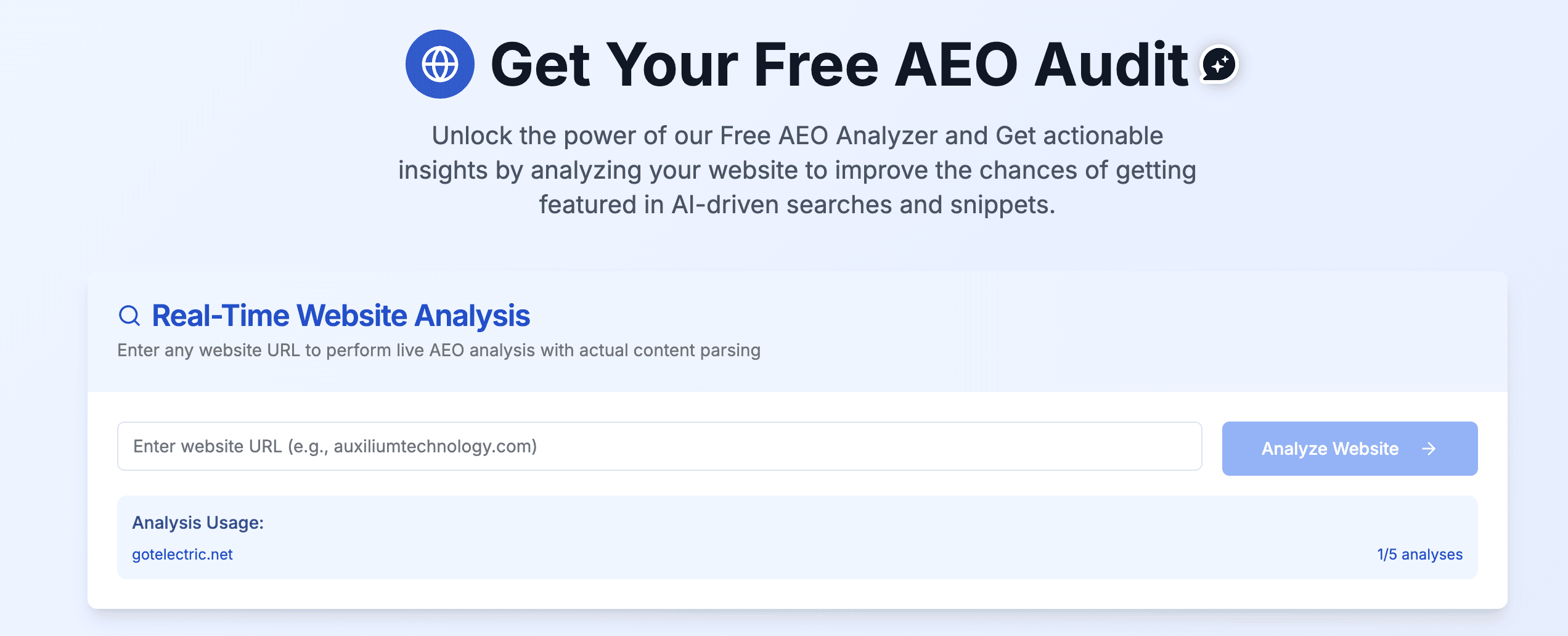
If you want a clearer picture of where your firm currently stands with AI platforms, a free AEO analysis is a useful starting point; it evaluates structured data, content clarity, and schema implementation in a few minutes.
FAQs About GEO for Law Firms
What is GEO for lawyers?
GEO for lawyers means structuring legal content so AI tools like ChatGPT and Google AI Overviews can confidently cite and recommend a firm within a generated answer.
How is GEO different from SEO?
SEO earns a ranking position and a click. GEO earns a direct citation inside an AI-generated answer. They rely on overlapping technical work but measure different outcomes.
Does my firm need schema markup for GEO to work?
Not strictly, but it significantly improves the odds. Schema gives AI systems explicit context instead of forcing them to infer your practice areas and credentials from unstructured text.
Is GEO worth it for a small or solo firm?
Yes. Citation slots inside AI answers are still relatively uncrowded in most practice areas, which favors firms that act now over firms that wait until every competitor is already doing it.
How long does it take to see GEO results?
It varies by platform and practice area, but most firms see measurable movement in AI citation frequency within a few months of consistent schema and content work, similar to organic SEO gains.
Ready to see how your firm shows up in AI search? Schedule a strategy consultation with the Auxilium Technology team.