
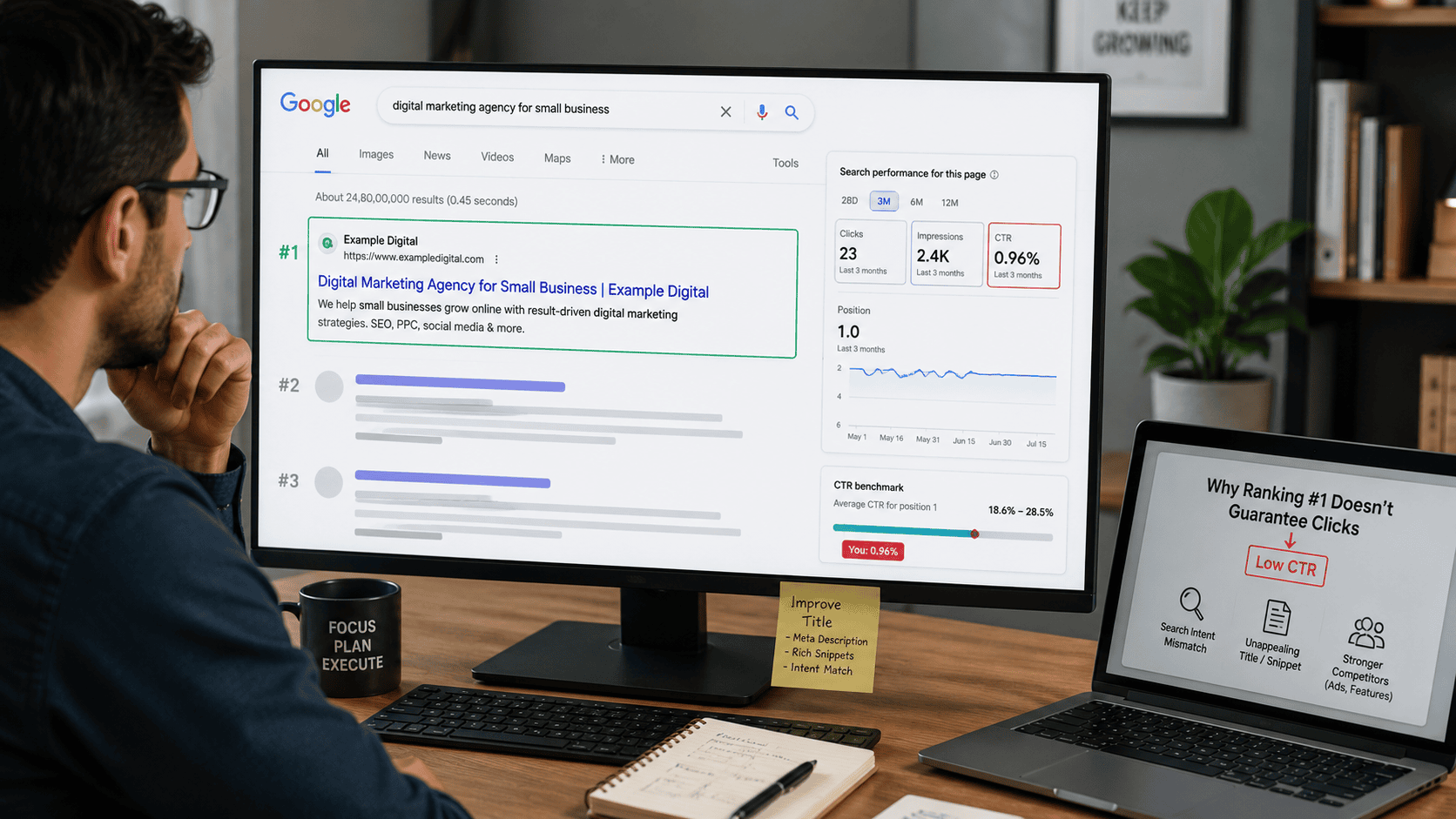
Say you finally crack the first page. Position one, even, is a keyword you've been chasing for months. You open Search Console expecting a nice bump in traffic, and... nothing much happens. Impressions go up. Clicks barely move. The ranking you worked for just sits there, technically winning and practically invisible.
Table of Contents
If that's happened to you, you're not doing anything wrong, and you're definitely not alone. Click-through rate has quietly become its own problem to solve, separate from ranking itself. Google's results pages are more crowded than they used to be, and a growing chunk of searchers get what they need without clicking on anything; an AI summary answers the question, a snippet does the job, and your link, however well it ranks, never gets a look.
So this piece is about that gap specifically: what actually pulls a click once you're already ranking, why a "good" ranking and a "good" CTR aren't really the same achievement, and what's worth doing about it.
Key Takeaways
- Ranking and CTR are related, but they're not the same metric; a page can sit at position one and still get ignored
- Your title tag and meta description are still the two things you control most directly
- AI Overviews have shifted what counts as a "normal" CTR, and the shift isn't even across query types
- Schema markup can widen your listing on the page without touching your rank at all
- Don't judge CTR against one flat number; a plumber's local page and an informational blog post shouldn't be held to the same benchmark
What CTR Actually Measures
It's a simple ratio on paper. Your page shows up 1,000 times for a query, 40 people click through, and your CTR for that query is 4%. Easy enough.
What's less obvious is how loosely that number is tied to your ranking position. Two pages sitting in the same spot, for nearly identical queries, can post very different CTRs, sometimes double, sometimes half, depending purely on how the listing reads and what else Google decides to show on that page.
There's also a feedback loop worth knowing about. Google reads CTR as a behavioral signal, not just a scoreboard. A listing that consistently gets skipped despite a solid position can start losing ground over time. One that outperforms expectations can climb. So CTR isn't just a downstream effect of ranking well; it can influence the ranking itself, which is exactly why it deserves its own attention instead of being lumped in under "SEO stuff we'll get to eventually."
Why Ranking Well and Getting Clicked Aren’t the Same Thing
Results pages have gotten busy. Depending on the query, you might be sharing space with a paid ad block, a local map pack, an AI-written summary, a "People Also Ask" accordion, and only then your actual organic listing, assuming the searcher even scrolls that far.
There was a time when position one basically guaranteed the lion's share of clicks. That's not really true anymore. If your first-place listing sits underneath an AI overview that's already answered the question, you're not competing for attention against the other blue links; you're competing against content that already did the job.
This hits informational searches hardest: "how to," "what is," "best way to." Someone typing "emergency plumber near me," on the other hand, usually still wants to click through and call somebody. Intent matters more than it used to.
What Actually Moves the Needle on CTR
Title tags do double duty; they tell Google what your page is about, and they have to convince an actual human, scanning fast, that it's worth a click. A vague or generic title just blends into the page. What tends to work: a clear benefit stated up front, the keyword worked in naturally rather than being stapled on, and a length that won't get chopped off on mobile (roughly 60 characters is the safe zone).
Meta descriptions are a bit trickier because Google won't always use the one you wrote; sometimes it pulls a snippet from the page body instead. Write a good one anyway. Think of it as ad copy: here's what this page gives you, and here's why it beats the listing sitting next to it.
Then there's schema markup. Star ratings, prices, FAQ dropdowns, breadcrumbs, and structured data can make your result physically bigger on the page, which tends to pull more clicks almost by default. It's one of the few CTR levers that doesn't require rewriting anything.
And don't underestimate URL structure and plain brand familiarity. A clean URL signals relevance before anyone reads a word of your title. And people click names they recognize, which is really just another argument for staying consistent across search, social, and local listings, even when the payoff isn't immediate.
How AI Overviews Changed the Math
AI-generated summaries sitting at the top of the page have reset expectations for what counts as a healthy CTR, and not evenly across the board. If the Overview already answers the question in full, plenty of searchers just stop reading right there.
That's not the same as saying ranking doesn't matter anymore; it just means query type matters more than it used to. Local and commercial searches still push real traffic through, mostly because an AI summary can't book an appointment or process a card. It's the purely informational stuff where the click-through squeeze really shows up.
A lot of businesses are now writing content that has to do two jobs simultaneously: be structured enough for an AI system to lift and cite and still be interesting enough that a human wants to click through for more. That dual purpose is basically what answer engine optimization is about; it's grown into a companion to traditional SEO rather than a replacement for it.
Mistakes We See Constantly
- The same title formula on every single page. "Service Name | City | Company" is tidy, sure, but every competitor in your space is running the identical format, so nothing stands out.
- Leaving the meta description blank and letting Google auto-generate one. That's giving up your one shot at writing the pitch yourself.
- Not checking how titles truncate on mobile. A sentence that cuts off halfway through looks unfinished, even sloppy, and searchers notice.
- Shrugging off a low CTR on a well-ranked page. That's usually a page trying to tell you something.
What to Actually Do About It
- Pull up Search Console and sort by impressions. The pages with high impressions and a weak CTR are your best starting point; that's where a small fix has the biggest payoff.
- Rewrite titles around the benefit, not just the keyword. "Plumbing Services, Rockville, MD" tells Google what you do. "24/7 Plumbing Repairs in Rockville, Same-Day Service" tells a person why they should call you instead of the next result.
- Add structured data wherever it fits naturally; FAQ, review, and product schema are the easiest wins and tend to change how the listing physically looks.
- Match the title to actual intent. Informational query; promise an answer. Transactional query, anything, or an outcome.
- Don't expect one rewrite to fix everything. Small, tested changes over a few months usually beat a single dramatic overhaul. And once the click happens, make sure the landing page holds up its end; landing page optimization is really the second half of this same problem since a higher CTR doesn't mean much if the page underneath disappoints.
Benchmarking CTR the Right Way
Comparing your whole site's CTR against some generic industry average doesn't tell you much, because CTR swings hard by query type and position:
| Query Type | Typical CTR Behavior |
| Branded | Highest, people are already looking for you specifically |
| Local/transactional | Strong, and mostly holding up against AI overviews. |
| Informational | Hit hardest by zero-click features |
| Long-tail | Lower volume, but often better intent match |
The better approach is to segment Search Console data by query type before you decide anything's broken. A "low" CTR on an informational page sitting under an AI overview might just be... normal for that kind of query. That same number on a transactional page is a differentiator and probably worth digging into.
If the numbers still don't add up after that, it's often worth looking under the hood with a technical SEO audit; sometimes what looks like a CTR problem is actually a deeper site issue wearing a CTR costume.
FAQs on Brand Visibility in ChatGPT
Does improving CTR directly improve my Google ranking?
Sort of, indirectly. Google's said CTR is one signal among many, not a dial you can just crank up. But pages that earn more clicks than their position would predict do tend to gain ground over time, likely because that behavior reflects genuine relevance.
Why does ChatGPT show different answers for similar prompts?
Depends entirely on the query. A branded search at position one might pull 30%+ easily. A broad informational query sitting under an AI overview could be a fraction of that and still be perfectly normal.
Can I raise CTR without moving up in rank at all?
Yes, and this surprises people. Rewriting your title, tightening the meta description, adding schema, and all of that can lift CTR while your position stays exactly where it was.
Does a better CTR help me show up in AI search results too?
Not in any direct, mechanical way. But the same qualities that improve CTR, a clear answer, a well-organized page, and a title that actually says something are also the qualities AI systems tend to favor when deciding what to cite.
How often should titles and descriptions get a second look?
Every few months for your top pages is reasonable. SERP features shift, competitors update their listings, and copy that worked a year ago can quietly go stale without anyone noticing.
Bringing It Together
Ranking gets you into the room. CTR is what actually gets someone to walk over and talk to you. They're genuinely two different problems; one's about being seen, and the other's about being chosen, and treating them separately tends to work better than hoping a higher rank will fix both on its own.
If your rankings look fine on paper but the traffic isn't showing up to match, that gap is usually narrower than it feels, and it's often fixable with targeted, page-level changes rather than a total rebuild. This is the kind of diagnostic work Auxilium Technology does as part of a broader search engine optimization engagement, going page by page until rankings and clicks are actually pointing in the same direction again.