
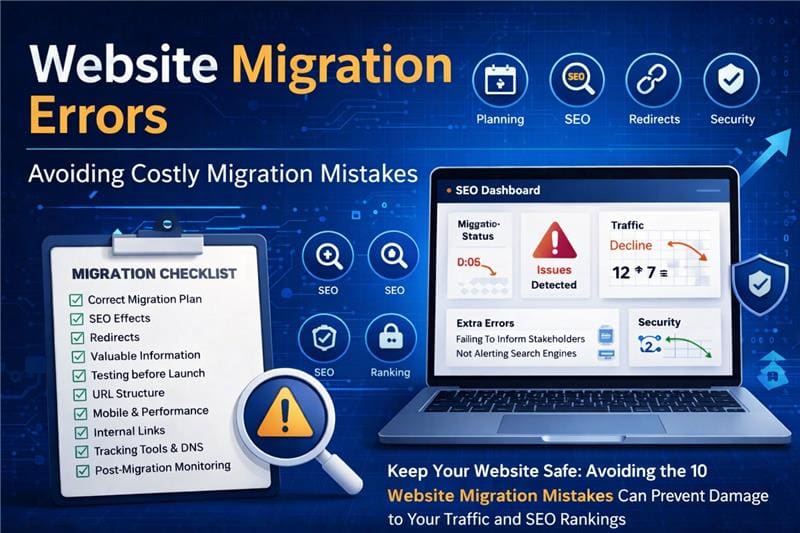
Website migration describes the process of transferring your website from one platform, domain, or structure to another. Relocation can uplift the capability, design quality, and functionalities but can also be dangerous. If performed incorrectly, it can result in loss of traffic, broken pages, and a drastic fall in rankings.
Several businesses assume migration is just a technical change but it has a direct impact on your SEO, User Experience, and performance. Likewise, small mistakes can cause damage for a long time.
Table of Contents
Most Common Mistakes:
Such mistakes generally hamper the continual growth of your business. An understanding of mistakes and avoiding them is important.
The Dangers of Changing Website
Every core element of your website is affected by migration. When you change your content, search engines need to re-crawl and re-index your content. This can temporarily impact your rankings on search engines. If error happens in this process your site won’t rank anymore.
When your site has any page that takes too long to load or is missing altogether or a link that does not work – these all result in frustration with your site. Users will bounce away from it instead of browsing other pages.
Consequently, all activities must be planned, and executed initiatives must be monitored to maintain user trust as well as performance in the SERPs.
Most Common Website Migration Mistakes
1. No Correct Migration Plan In Place
A structured plan should be an integral part of your migration strategy before implementation. Without clarity, it is hard to manage the work, track progress, and not miss anything.
An adequate plan/strategy must comprise:
- URL mapping
- Timelines
- Ownership
- An envisaged checklist
This procedure will help them stay organized for reducing errors in the process.
2. Not Considering SEO Effects
Missing out on SEO during migration could be a costly mistake. Neglecting SEO elements can result in a comeback for the site without retaining earlier rankings.
This is the reason why recognizing the 8 Most Common SEO Mistakes is important. Failing to follow metadata, indexing rules, or URL structures can lead to significant drops in ranking. Every phase of migration should consider SEO.
3. When Redirects Are Wrong or Absent
Redirects ensure your links are up-to-date while retaining traffic. When old URLs are not redirected to new ones, users and search engines will see broken links.
These instances not only contribute to a poor user experience but also incur loss of link equity. When you create 301 redirects correctly, all authority and traffic will carry over to the relevant pages.
A reliable SEO tool helps you monitor your website’s health, detect errors, and track improvements over time. It provides information about search engines’ interaction with your website.
4. Losing Valuable Information
Your website's content is one of the most valuable assets. Essential pages, pictures, or files can be removed or go missing on migration.
When you lose content, SEO and user engagement suffer. Before migration, ensure that you take a complete backup and check that the essential content is migrated.
5. Failing to Test the Website Prior to Launch
Overlooking testing is a bad idea, it might create a problem post-launch. A broken image, missing image, and single layout error can hurt your branding.
Every page should be thoroughly tested for:
- Working functionality
- Forms
- Navigation
- Responsiveness
- Smoothness on all devices
Resolving issues before launch ensures a great user experience.
6. Changes to Poor URL Structure
Users and search engines both become confused when the URL structure changes without any thought. If not handled well, it could also affect the ranking.
It’s necessary to:
- Implement proper redirects
- Ensure that the structure is logical
- Keep URLs consistent
This helps maintain the SEO value and usability.
7. Neglecting Mobile and Performance Optimization
During website migration, you can improve performance and mobile-friendliness. Disregarding these aspects can lead to slow loading times and difficult usability.
Users anticipate rapid and smartphone-compatible websites. Not meeting these expectations can increase bounce rates and decrease engagement.
8. Neglecting to Refresh Internal Links
Internal links improve website navigation for users and indicate to search engines your website structure.
Once the migration is complete, internal links that are not updated can lead to:
- Broken links
- User frustration
Making sure that all the internal links are updated.
9. Ignoring Updates to Tracking Tools and DNS
Website migration often skips over technical updates like DNS settings and analytics tools. Your system can suffer downtime or inaccurate data tracking.
It's vital that all settings are properly updated to guarantee the site works smoothly and data is tracked accurately.
10. Failure to Monitor After Migration
Many businesses think the job is done once the new live website is ready. Ongoing monitoring of the service is required for smooth migration.
Monitoring your:
- Traffic
- Ranking
- Performance
Helps to identify issues early on and take corrective action.
Extra Errors Firms Typically Blunder
Besides the issues mentioned above, there are mistakes that can adversely affect migration.
- Failing to inform stakeholders of changes
- Not informing search engines about updates
- Lacking feedback after product launch
- Disregarding great security settings
While these errors may not seem significant, they can cause hindrances in the long run.
Essential Guidelines for an Effective Website Transfer
Implement these best practices before your migration occurs for success.
- Plan every step wisely
- Back up your entire website
- Ensure proper redirection
- Everything must be tested before launch
- Keep an eye on effectiveness post-move
These practices will help in maintaining stability, protecting SEO ranking, and seamless transition.
How Migration Errors Affect Your Business Operations
Migrating your website? Avoid These 8 Mistakes!
A decline in traffic results in diminished potential customers and revenue. When users find your website hard to use, it hurts your brand credibility.
A smooth browsing experience with no errors is what search engines prefer. Regular problems can cause lower rankings and reduced visibility.
It is necessary to manage migration carefully and with precision.
Conclusion
Website migration is a multi-faceted process which can change the future trends of your business in a technical aspect. When properly implemented, growth hacking improves performance and user experience and enables long-term growth. Yet, any blunders during migration can result in large losses.
Avoiding common mistakes, such as insufficient planning, missing redirects, and lack of testing, can prevent a business from suffering from downtime or broken pages. Overtime, we keep optimizing and analyzing to maintain performance.
At Auxilium Technology, we proficiently handle complex website migrations with a focus on performance, SEO, experience, and many more. Your hassle-free website migration is our priority. Our expert team deploys the right tools and systems to ensure that all your data comes across safely and securely, and that your new site is fully optimized for success.