
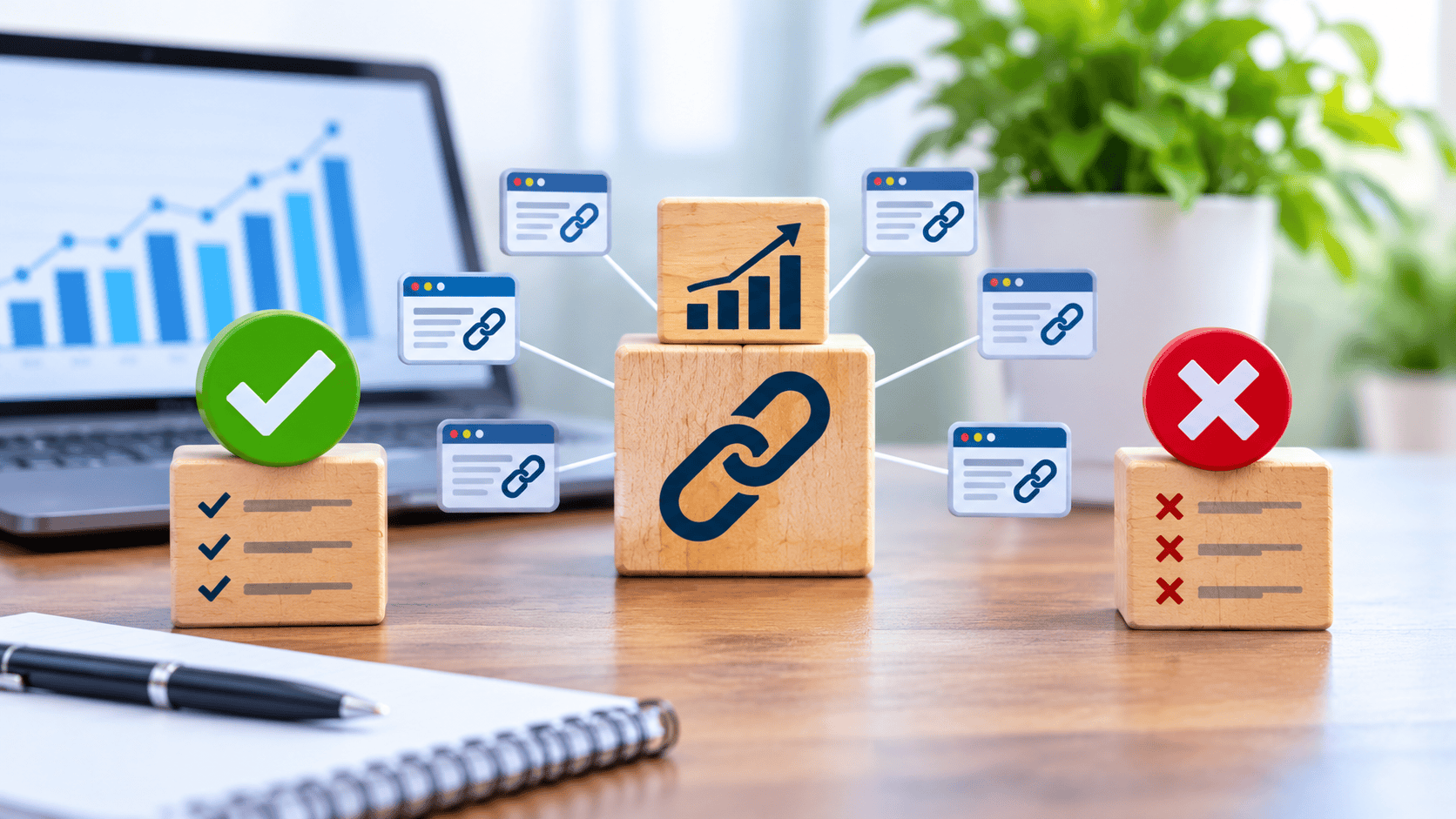
With link-building services, you’re paying a provider to get relevant, trustworthy websites to link to yours through research, content, and manual outreach, with reporting on every link. What to avoid is the opposite: bulk packages of cheap links, private blog networks, guaranteed rankings, and providers who won’t tell you where your links will appear. Those are the ones that can get your site penalised. The rest of this guide shows how to tell which one you’re buying.
Table of Contents
Objective: Help business owners and marketing managers understand what link building services deliver, what a managed service covers, and how to spot a provider that could harm their site.
What a link-building service actually does
A backlink is a link from someone else’s site to yours. Link building is the deliberate effort to get more of them from sites that matter.
Plenty of companies try it in-house and quit after a month. It’s slow. You research sites, write pitches, get ignored by most of them, follow up, and eventually land a handful of links. That’s why an SEO link building service exists: someone else absorbs that grind.
The good ones don’t just “get links". They work out why a publisher would bother linking to you. Maybe it’s a guest article, a stat nobody else has published, or a resource that fills a gap on their page. If there’s no reason for the link to exist, it’s probably a paid placement in disguise.
Why links still matter
Google has used links as a ranking signal since the beginning, and that hasn’t gone away. They aren’t the only factor. A page with weak content won’t be rescued by links, and a great page with zero references often loses to a competitor who has some.
Links also send actual visitors. A mention on a site your customers already read can produce enquiries that have nothing to do with rankings.
What “managed” means
A managed link-building service means the provider runs the whole process instead of emailing you a spreadsheet of sites. Scope varies, so ask, but expect most of this:
- A look at your existing backlinks and what competitors have
- A plan for which pages to promote
- A vetted list of target sites, checked for real traffic
- Content written to earn the link, such as guest posts or resource pages
- Outreach emails sent by a person
- Monthly reporting listing every live link and where it points
Ask for a sample report before signing anything. If they can’t show one, you’ve learned something.
Manual vs. automated
Manual link building means a human picks the site, writes the pitch, and checks the result. It costs more because it takes time. Every link also has a reason to exist.
Automated link building means software, networks, or mass directory submissions. You get volume fast, and you also get exactly what Google’s spam policies target: private blog networks, comment spam, link farms. The saving looks great until rankings drop and you pay someone to clean it up.
Automation isn’t evil everywhere. Tools that find prospects or track replies save real time. The test is simple: did a person decide this link should exist, and could they explain why?
How to spot a safe, ethical provider
Safe link building is mostly about transparency. A provider worth hiring will:
- Tell you what kinds of sites they target and how they judge quality
- Refuse to guarantee rankings or a fixed number of links
- Avoid networks built to sell links
- Give you a written scope, including what happens if a link disappears
- Talk about your business, not a generic package
Be suspicious of very cheap per-link pricing, no past examples, and “high DA links” pitched without any mention of relevance. Domain authority is a third-party metric. Google doesn’t use it, so a big number tells you very little.
Authority link building: fewer, better links
Ten links from respected, relevant sites usually do more than a hundred from sites nobody reads. Authority link building aims at industry publications, trade bodies, established blogs, and local organisations tied to your market.
Relevance comes first. A plumber gains almost nothing from a link on a gaming blog, however strong that blog looks in a tool. The question to ask is whether a real reader of that page would have a reason to click through to you.
Key takeaways
- Link building services get relevant, trustworthy websites to link to yours, which supports your visibility in search.
- Manual outreach is slower than automated link packages and far safer.
- A managed service should cover research, content, outreach, and reporting; you can check yourself.
- Relevance beats volume. A few good links outperform hundreds of weak ones.
- Guaranteed rankings and bargain prices are the clearest warning signs.
Link building for small businesses
Small businesses sometimes assume this is only for companies with large budgets. It isn’t, but it has to be focused.
You don’t need hundreds of links. You need a modest number of good ones pointed at the pages that make you money. Start there. Make sure those pages are worth linking to, because outreach for a thin page is wasted effort. Then pick a monthly budget you can keep up. A small steady programme beats one big push followed by nothing.
And be patient. Links need to be found, indexed, and weighed, so think in months, not days.
Where Auxilium fits
Auxilium Technology offers link building as part of its SEO services, built around relevance and manual outreach. You can see what’s covered and how it works on the link building services page.
FAQ
What is a link-building service?
A service where a provider earns or places links to your site from relevant, reputable websites to strengthen its credibility in search.
What does a link-building service include?
Usually a backlink audit, strategy, site research, content creation, outreach, and reporting on every link built.
Is link building safe?
It can be, if it’s manual, relevant, and not designed to manipulate rankings. Paid link schemes and automated networks carry real risk.
How much do link-building services cost?
It depends on scope, site quality, and content needs. Very low per-link prices usually signal low-quality sites.
How long does it take to see results?
Typically a few months. No honest provider can promise a timeline.