If your website isn’t ranking even with superb content, you might not need to look at your keywords or your backlinks but your technical SEO.
Table of Contents
Technical SEO is the backbone of your website. Google and the other search engines crawl, understand, and rank your content with it. In the absence of SEO, no matter how well-designed your website is, it won’t show up in search results.
In this technical SEO guide, we will break things down for you in simple terms, as well as take you through a complete checklist.
Objective of the Blog.
This blog aims to:
- Explain technical SEO in a simple and practical way
- Provide a step-by-step checklist
- Help you identify and fix common technical issues
- Guide you toward improving your website’s search visibility
What is Technical SEO (and Why is it Important)?
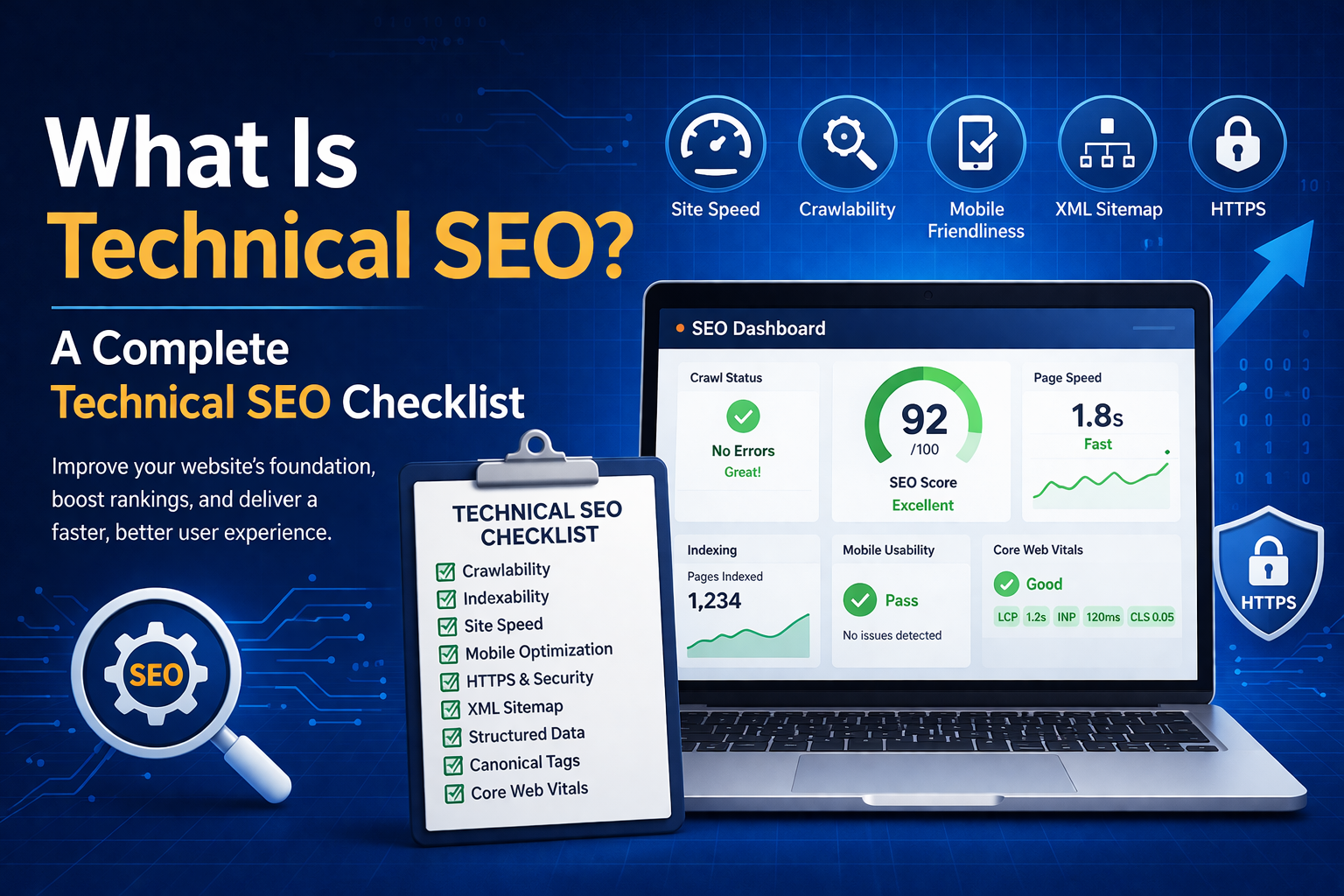
Improving your website's infrastructure and back-end elements so that search engines can easily crawl, index, and render the pages refers to technical SEO.
It is like making a structure on which your website is built. If your SEO isn't structured, it's not going to work.
Technical SEO focuses on:
- How search engines access your site
- How your pages are indexed
- How fast and user-friendly your website is
Key Takeaways.
- Search engines need good technical SEO for great visibility.
- The ranking of your page is impacted by the experience and speed of your site.
- Ensure proper optimization of crawlability and indexing.
- Well-organized data enhances search appearance.
- Performing audits of your website is helpful in maintaining your website's health.
- Expert guidance can simplify complex SEO tasks.
Best Technical SEO Checklist
Mention technical SEO, and many people assume it’s overly complex. In reality, if you break up the task into small steps, it becomes quite easy. Here’s a handy and elaborative technical SEO checklist for your website that you can follow easily.
1. Make use of the appropriate SEO tools.
Selecting the right tools is one of the first technical SEO steps. It is a painstaking process to identify and fix technical issues without the right tools.
A reliable SEO tool helps you monitor your website’s health, detect errors, and track improvements over time. It provides information about search engines’ interaction with your website.
Look for tools that offer.
- Website inspection reports to discover technical problems.
- Monitoring and tracking of a keyword’s performance.
- Identifying Indexing Problems through Crawl Analysis
- Recommendations for internal links.
Incorporating an advanced software tool into your process will help you to save time while making your technical SEO actions data-driven.
2. Improve Your Page Experience
Page experience is one of today’s most important ranking factors because it shows how users interact with your website.
Search engines evaluate page experience using several signals.
Core Web Vitals
These metrics gauge how people interact with your website.
- Largest Contentful Paint (LCP) analyzes your site’s response time (how fast the main content loads).
- Interaction to next paint (INP) is the responsiveness of your page when users interact with the content.
- Cumulative layout shift (CLS), which measures visual stability as web pages load.
Responsive Design
Because most users browse your site on their mobile devices, it must shape itself to the smaller screen.
The security of a website plays a vital role in the user experience. When a website feels secure to users, they are averagely more interactive and for a longer time.
This is why search engines like Google use HTTPS as a measurement for page experience.
What differentiates HTTP from HTTPS?
The key difference lies in HTTPS secure encryption, and HTTP lacks that encryption. To prevent spammers, viruses, and hackers from coming into contact with their customers, many of the world’s largest organizations encrypt their web pages and applications.
Intrusive Interstitial Elements
Using popups or overlays that obstruct content can impair user experience and rankings.
Enhancing the experience of the page hampers the bounce rate of the page, improving the quality score of the page and thus getting it ranked on Google.
3. Investigate crawl error issues.
Overall, search engines use bots to crawl your website and discover content. If these bots encounter errors, your pages may not be indexed properly.
Frequent crawl problems involve.
- Broken links leading to non-existent pages.
- Redirect loops or chains
- Pages blocked unintentionally
- Server errors
Regularly auditing your website ensures that search engines can access all important pages without interruptions. A desirable ranking is achievable with the smoother crawling process.
4. Build a User-Friendly Site Architecture.
The manner in which the pages of your site are arranged and linked together is called site architecture.
A good layout of a website helps the users and search engine easily navigate through it. If the users are able to find what they need quickly, they will spend more time on your site. This sends good signals to the search engines.
The essential components of a successful architecture include.
- Clear navigation menus
- Logical content categories
- Proper internal linking
- Simple and organized structure
A robust structure of the site enhances your usability and SEO.
5. Enhance the Quality of Your Robots.txt File.
The robots.txt file essentially communicates with crawlers regarding the pages they can access and the pages they shouldn’t.
This is very helpful to stop search engines from crawling unnecessary pages like this.
- Admin panels
- Login pages
- Pages with duplicates or lower value.
However, wrong configurations can block essential pages from indexing. This is why you must review and optimize the robots.txt file carefully.
A properly optimized robots.txt file makes sure that search engines crawl only the important pages of your website.
6. Make and Improve Your XML Sitemap.
An XML sitemap is a blueprint of your website that informs the search engines about the structure of your site.
It shares crucial information, including.
- Which pages exist on your site
- How pages are connected
- When content was last updated
A properly optimized sitemap:
- Speeds up indexing
- Helps search engines discover new pages
- Improves overall crawl efficiency
Regularly update your sitemap and submit it to search engines.
7. Make Use of SEO-Friendly URLs.
The URL structure is very important for SEO and user experience.
URLs that are preferred by search engines.
- clear and easy to understand.
- Keywords that are descriptive.
- Free from unnecessary characters or numbers
A clean URL lets users know what to expect before clicking, aiding site trust and improving click-through rates.
Keeping them short and meaningful makes them easier for your audience to understand and search engines to index.
8. Correct Duplicate Content Errors.
When similar or identical content appears on multiple URLs, it is termed "duplicate content." Search engines get confused and find it difficult to choose which page to rank for that.
As a result:
- Ranking signals may get split
- Pages may not rank at all
- Search engines may ignore duplicate versions
- To fix duplicate content:
- Utilize canonical tags to show the preferred one.
- Redirect duplicate pages to the main page.
- Consolidate Similar Content
Taking care of duplicate content makes sure that your SEO efforts are emphasizing the right pages.
9. Add schema markup.
Schema markup, or structured data, helps search engines understand the content on your site. The search engine and a human think differently. Schema is like a translator that tells the search engine what your content is about.
Advantages of schema markup are:
- Enhanced search listings (rich snippets).
- Greater visibility on search results.
- Improved click-through rates.
It allows engines to tell your website is related to particular topics and industries, which also helps entity SEO.
10. Perform Regular Technical SEO Audits.
It takes continuous monitoring to take care of technical SEO.
Regular audits help you:
- Identify hidden technical issues
- Fix errors before they impact rankings
Make sure that your website is in sync with the updates of search engines.
Many businesses rely on technical SEO audit services in Maryland to get a detailed analysis of their website’s performance.
When you have technical SEO experts or a technical SEO consultant in Maryland by your side, you will be able to stay and become competitive. Hires technical SEO services in Gaithersburg to maintain long-term SEO success.
Why Work with Technical SEO Experts?
Technical SEO is not something done once and forgotten. It requires continual checking and updating while staying in tune with search engines. Fixing crawl errors, speeding up your website, and implementing structured data are just a few examples of small technical issues that can affect your rankings.
This explains the reason why many businesses work with technical SEO experts who can find underlying problems and apply the right solutions in addition to ensuring their entire website is up-to-date with the latest SEO recommendations.
If you’re looking for help from a Maryland consultant for technical SEO or professional technical SEO services in Gaithersburg, working with experts can keep you ahead of competitors, maintain a healthy website, and deliver more consistent long-term results.
About Our Technical SEO Services.
At Auxilium Technology, we provide data-driven solutions that enhance the technical performance of your website. We do everything from fixing crawl errors to speeding up your site and implementing structured data in technical SEO.
We are one of the trustable technical SEO audit service providers in Maryland who identify issues while optimizing websites and build a strong foundation for a business with their help.
What is technical SEO?
Technical SEO is basically optimizing your site’s backend for search engines so they can crawl, index, and understand your content. The elements include site speed, mobile responsiveness, URL structure, and structured data.
What is the importance of SEO?
Technical SEO removes barriers preventing your site from ranking. Slow speed, crawling, and structure problems can prevent even high-quality content from ranking.
How frequently should I carry out a technical SEO audit?
According to guidelines, a technical SEO audit should be carried out every 3–6 months.
In Maryland, many businesses choose to work with providers offering technical SEO audit services to ensure nothing gets overlooked.
Is it necessary to hire a technical SEO expert for my site?
With basic improvements, you can do it by yourself; however, the business, which is growing, will require some assistance from a technical SEO expert. Expert guidance ensures steady performance whether you’re obtaining assistance from an expert in Maryland or availing technical SEO services in Gaithersburg.