
Object-Oriented Programming (OOP) is one of the most powerful programming paradigms used in modern software development. It allows developers to structure applications using reusable and scalable components called objects. When combined with Python’s simplicity and flexibility, OOP becomes an incredibly effective approach for building robust applications.
Table of Contents
In this blog, we will explore OOP in Python, understand its core principles, and look at practical examples to help you grasp the concepts clearly.
What is OOP in Python?
Python supports multiple programming paradigms, but OOP is one of its most widely used approaches. Object-Oriented Programming is based on the concept of “objects,” which are instances of classes. A class acts as a blueprint, while an object represents a real-world entity created from that blueprint.
OOP helps developers organize code logically, reduce duplication, and improve maintainability. It is especially useful when working on large-scale projects.
Core Principles of OOP in Python
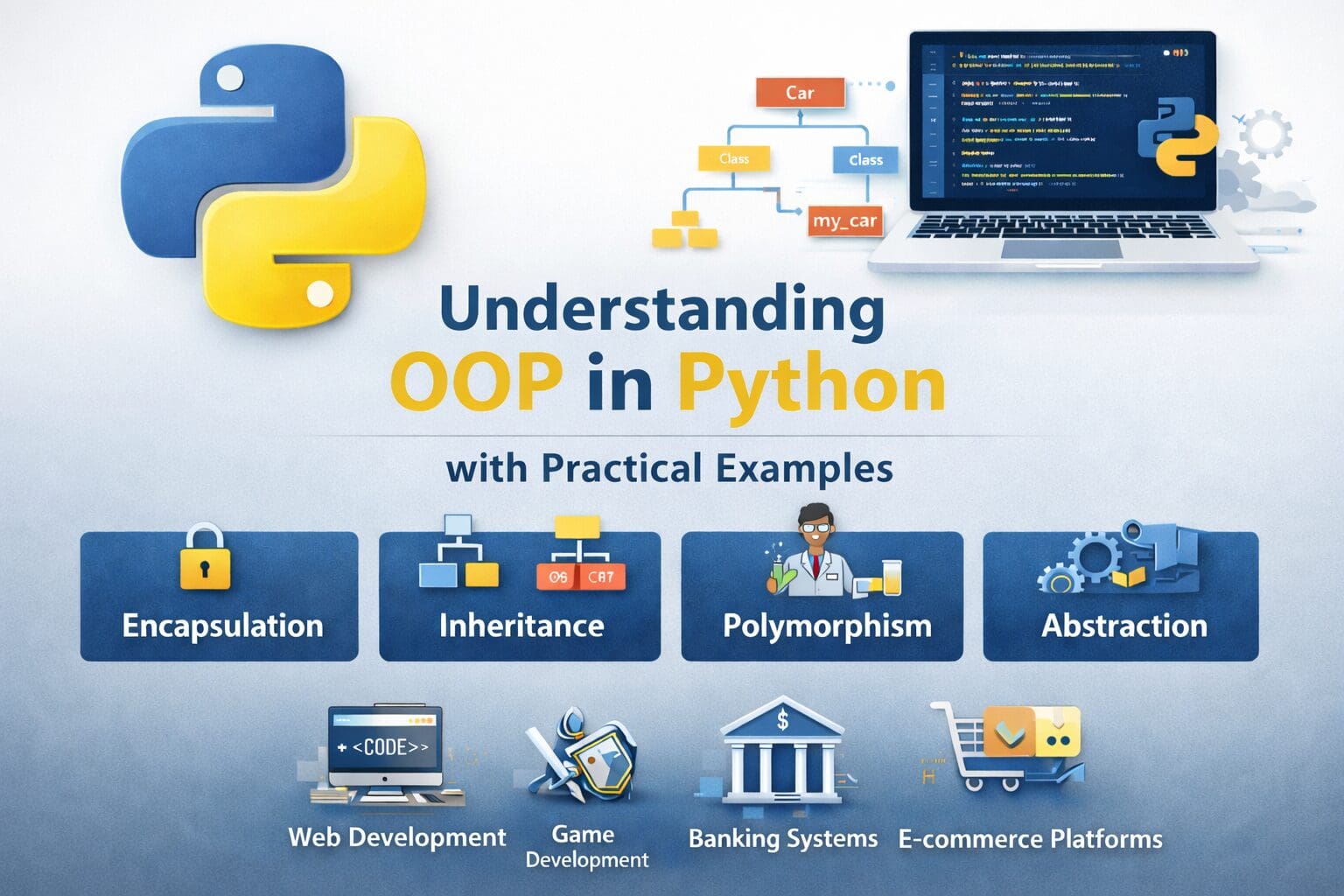
There are four fundamental pillars of OOP:
- Encapsulation
- Inheritance
- Polymorphism
- Abstraction
Let’s understand each with simple practical examples.
1. Encapsulation
Encapsulation means bundling data (variables) and methods (functions) inside a class while restricting direct access to certain details.
Example:
class BankAccount:
def __init__(self, balance):
self.__balance = balance # private variable
def deposit(self, amount):
self.__balance += amount
def get_balance(self):
return self.__balance
In this example, __balance is private and cannot be accessed directly from outside the class. Instead, it is controlled through methods like deposit() and get_balance().
Encapsulation improves data security and ensures better control over modifications.
2. Inheritance
Inheritance allows one class to inherit properties and methods from another class. It promotes code reusability and reduces redundancy.
Example:
class Animal:
def speak(self):
print("Animal makes a sound")
class Dog(Animal):
def speak(self):
print("Dog barks")
Here, the Dog class inherits from the Animal class. It can use the base class functionality while also modifying behavior. This makes development efficient and structured.
3. Polymorphism
Polymorphism means “many forms.” It allows methods to perform different tasks based on the object calling them.
Example:
class Bird:
def fly(self):
print("Bird flies")
class Airplane:
def fly(self):
print("Airplane flies")
def make_it_fly(entity):
entity.fly()
Both Bird and Airplane have a fly() method, but their implementations differ. The function make_it_fly() works with both objects, demonstrating polymorphism.
Polymorphism increases flexibility and simplifies code management.
4. Abstraction
Abstraction hides complex implementation details and shows only essential features.
Example:
from abc import ABC, abstractmethod
class Shape(ABC):
@abstractmethod
def area(self):
pass
class Rectangle(Shape):
def __init__(self, length, width):
self.length = length
self.width = width
def area(self):
return self.length * self.width
Here, Shape defines an abstract method area(). Any subclass must implement it. This ensures a consistent structure while hiding internal logic.
Why OOP is Important in Python
OOP plays a critical role in building scalable and maintainable applications. Some key benefits include:
- Code reusability
- Better organization
- Improved security
- Easier debugging
- Scalability for large projects
OOP is widely used in frameworks like Django and Flask, where applications are structured using classes and objects.
Real-World Applications of OOP in Python
OOP in Python is used across industries:
1. Web Development
Classes manage user authentication, database models, and API structures.
2. Game Development
Game characters, environments, and behaviors are modeled as objects.
3. Banking Systems
Accounts, transactions, and users are structured using OOP principles.
4. E-commerce Platforms
Products, carts, payments, and users are defined as objects for better management.
By understanding OOP, developers can build enterprise-level applications with clean architecture and long-term scalability.
OOP and Modern Software Development
OOP in Python connects strongly with broader software concepts discussed in topics like What is Python? Features, Architecture & Real-World Applications? Understanding Python’s architecture makes it easier to see how OOP fits into the bigger picture of building scalable and efficient systems.
When businesses aim to build advanced platforms, they rely on structured programming approaches like OOP to ensure stability and maintainability.
Conclusion
Object-Oriented Programming in Python is a powerful approach that enables developers to create structured, reusable, and scalable applications. By understanding encapsulation, inheritance, polymorphism, and abstraction, developers can design systems that are easier to manage and extend.
Whether you are building web applications, automation tools, or enterprise software, mastering OOP is essential for professional growth in Python development.
At Auxilium Technology, we combine technical expertise with modern programming principles to deliver scalable and high-performance digital solutions. By leveraging advanced Python development strategies and structured programming methodologies like OOP, we help businesses build future-ready applications that drive long-term growth and innovation.