

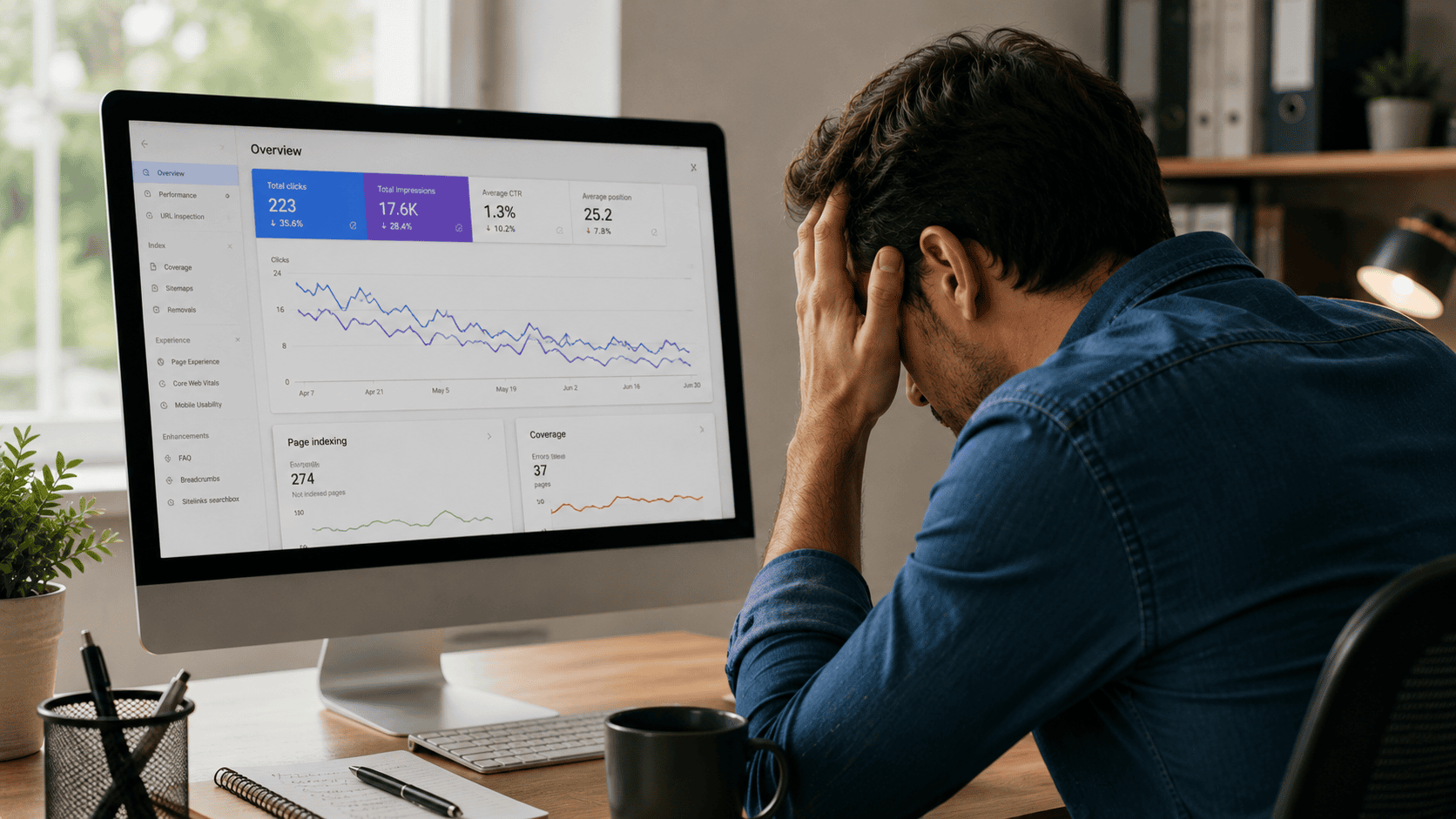
When organic traffic drops, the first instinct is usually to look outward. Did Google roll out an update? Did a competitor overtake us? It’s an understandable reaction, because an algorithm change is out of your hands, and that makes it a comfortable explanation.
Table of Contents
But in our experience at Auxilium Technology, many traffic declines trace back to problems inside the site itself: pages that aren’t indexed, services that were never given their own page, or tracking that quietly stopped working. Those are fixable, and they are worth ruling out before you assume the search results have turned against you.
Here is a practical way to work through it.
How Do You Know the Drop Is Real?
Before diagnosing anything, make sure the problem is real and understand its shape.
- Compare like with like. In Google Search Console’s Performance report, compare the same date ranges year over year, not just month to month. Many businesses have seasonal demand, and a quiet January isn’t a penalty.
- Separate clicks from impressions. A fall in impressions suggests you’re appearing for fewer searches or ranking lower. A fall in clicks with steady impressions points to weaker titles, more competition on the page, or search features absorbing clicks.
- Check the timing. A sudden cliff on a specific date suggests a discrete event, such as a site change, a technical fault, or an update. A slow slide over months suggests gradual content or competitive decay.
Then check whether Google confirmed an update on those dates. Google publishes ranking incidents and core updates on its Search Status Dashboard. If your drop lines up with a confirmed update, that is a real possibility. Google’s own guidance says core updates reassess content quality across the web, and that a decline doesn’t always mean something is broken on your site. If the dates don’t line up, look closer to home.
What Technical Problems Should You Rule Out First?
Technical faults are the most common reason traffic falls off a cliff, and they are often self-inflicted. They tend to appear after a redesign, a migration, or a plugin update.
Check these first:
- Accidental noindex tags or robots.txt blocks. A staging setting left on after launch can tell Google to ignore your pages.
- Indexing errors. The Pages report in Search Console shows which URLs are indexed and why others are excluded.
- Broken redirects after a redesign. If old URLs weren’t redirected to their new equivalents, rankings and the links pointing to those pages can be lost.
- Crawl errors and server issues. Frequent downtime or slow responses can limit how well your site is crawled.
If this sounds like a lot to untangle, a structured technical SEO review is usually the fastest way to find the cause.
Where Are the Gaps in Your Page Coverage?
This is one of the most overlooked issues, and it’s easy to miss because the site can look perfectly fine. If you offer ten services but only describe three, you can only rank for those three. The same applies to locations.
We saw this clearly with Cullison Excavating, a family-owned Maryland business we worked with. According to our case study, the company offered 33 services, but its previous website showed only seven main ones and none of the sub-services. It served 30 cities across three counties, yet the site covered only a handful of them. In practical terms, most of what the business actually did and where it worked was invisible to search engines.
If your traffic is soft, audit your pages against your real offering. List every service and every area you serve, then check that each has a page with a clear purpose. Pages that don’t exist can’t rank.
How Do Search Intent and Internal Links Affect Your Rankings?
Sometimes the page is fine, but it no longer matches what searchers want. Search the phrase you’ve lost ground on and look at what Google now shows. If the top results have shifted from product pages to guides or from guides to comparison tables, your page may be answering a different question than the one being asked.
Also look at how your pages connect:
- Orphaned pages. Pages with no internal links pointing to them are harder for Google to find and signal that they matter little.
- Competing pages. Two pages targeting the same phrase can split relevance between them instead of one clearly winning.
- Vague anchor text. Descriptive links such as “our local SEO services” help both users and search engines understand what’s on the other side.
What Makes Content Fall Behind Over Time?
Google’s guidance on helpful content asks whether a page shows real experience and expertise and whether it fully satisfies the reader. Pages written years ago and never revisited can fall behind newer, more complete competitors, even when nothing is technically wrong.
Review your declining pages and ask:
- Is the information still accurate and current?
- Does it answer the follow-up questions a reader would naturally have?
- Does it include something original, such as your own examples, data, or photos?
- Is it clear who wrote it and why they’re qualified?
Updating a declining page is often faster and more effective than publishing a new one. That’s an observation from our client work, not a promise of results.
Where Does Local Visibility Fit In?
For local businesses, a traffic dip can come from the Google Business Profile as much as the website. An incomplete profile, missing services, or outdated details can reduce how often you appear in local results.
In the Cullison case study, the company’s profile lacked listed services before we updated it. The case study reports that calls increased by 49% after the profile was optimized, alongside the other work done. If you rely on local customers, review your profile alongside your site, and consider local SEO support if the basics are already covered.
How Can You Tell If Your Tracking Is Broken?
Finally, check that the drop isn’t a reporting artifact. Analytics can break quietly after a site update, a tag change, or a consent banner change.
- Compare Google Analytics 4 against Search Console. If Search Console clicks are steady but analytics sessions fall, the issue may be tracking.
- Confirm your tag fires on every page, including new templates.
- Check that internal traffic filters and conversion events (key events in GA4) are still configured correctly.
What Does Fixing These Issues Look Like in Practice?
The Cullison case shows how addressing the basics can change results. Per our case study, over less than nine months, we rebuilt the site to display all 33 services and all 30 service areas, fixed on-site SEO problems left by the previous vendor, clarified calls to action, and updated the Google Business Profile.
The reported outcomes included an 84% increase in top-ranking keywords, 8,234% growth in impressions, 3,380% growth in clicks, and a 359% increase in users. Form submissions rose by more than 1,200%. These figures come from one client and reflect a site that was starting from a very low base, so we don’t present them as typical. What they do show is how much a site can gain when foundational problems are fixed. You can read the full breakdown in our Cullison Excavating case study.
What Should You Check First?
When traffic drops, work from the most fixable to the least:
- Confirm the drop is real and note when it began.
- Check for technical faults, especially after any site change.
- Audit page coverage for services and locations.
- Review search intent, internal links, and cannibalization.
- Refresh declining content.
- Check your Google Business Profile if you serve local customers.
- Verify that tracking is accurate.
If you work through all of these and still see a drop that matches a confirmed update, you’ll at least approach it with a clear picture of your site’s health and a better plan for recovery.
How Can Auxilium Technology Help?
Diagnosing a traffic decline is easier with fresh eyes and the right tools. If you’d like help finding what’s holding your site back, the team at Auxilium Technology can review your setup and point out the quickest wins. You can learn more about our SEO services or get in touch to start the conversation.