


What Is HTTPS and Why Does It Matter?
HTTPS (HyperText Transfer Protocol Secure) is the secure version of HTTP. It encrypts the data exchanged between a user’s browser and your website server, ensuring sensitive information such as login credentials, form submissions, and payment details cannot be intercepted. From an SEO and user trust perspective, HTTPS is critical. Modern browsers label non-HTTPS websites as “Not Secure,” which can immediately discourage visitors. Search engines like Google also prioritize secure websites in rankings, making HTTPS a must-have rather than a nice-to-have.Key benefits of HTTPS include:
- Secure data transmission between users and servers
- Protection against man-in-the-middle attacks
- Increased user trust and credibility
- Improved SEO performance
Understanding SSL Certificates
SSL (Secure Sockets Layer) is the technology that enables HTTPS. While the term SSL is still commonly used, most modern systems rely on TLS (Transport Layer Security), which is the updated and more secure version. However, “SSL certificate” remains the standard industry term. An SSL certificate authenticates your website’s identity and encrypts the data transferred between the browser and server. When installed correctly, users see the familiar padlock icon in the address bar, signaling that the site is secure.Common Types of SSL Certificates
Different websites require different levels of validation:
Table of Contents
- Domain Validation (DV):
Basic encryption, suitable for blogs and small informational websites. - Organization Validation (OV):
Verifies business identity, ideal for corporate websites. - Extended Validation (EV):
Highest level of trust, often used by financial institutions and eCommerce platforms.
Choosing the right SSL certificate depends on your website’s purpose, traffic, and data sensitivity.
How HTTPS and SSL Work Together
SSL certificates are the foundation of HTTPS. When a visitor accesses your site:- The browser requests secure communication.
- The server presents its SSL certificate.
- The browser verifies the certificate.
- An encrypted connection is established.
What Are Security Headers?
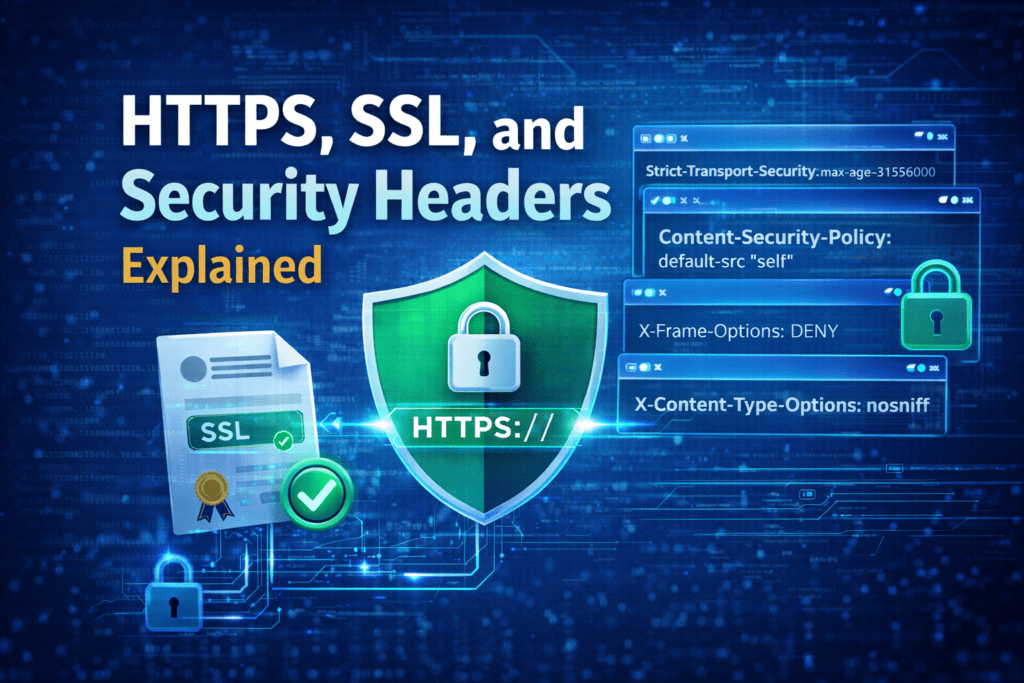
While HTTPS and SSL secure data in transit, security headers add another layer of protection at the browser level. Security headers are HTTP response headers that instruct browsers on how to behave when interacting with your website. They help prevent common cyberattacks such as cross-site scripting (XSS), clickjacking, and data injection.Important Security Headers You Should Know
Here are some essential security headers and their roles:
- Content-Security-Policy (CSP):
Controls which resources can load on your website, reducing XSS risks. - Strict-Transport-Security (HSTS):
Forces browsers to use HTTPS only, preventing downgrade attacks. - X-Frame-Options:
Protects against clickjacking by restricting how your site is embedded. - X-Content-Type-Options:
Prevents browsers from interpreting files as a different MIME type. - Referrer-Policy:
Controls how much referrer information is shared during navigation.
When configured properly, these headers significantly strengthen your site’s defense without affecting performance.
Why Website Security Matters for SEO and Trust
Search engines prioritize secure websites because they provide a safer experience for users. HTTPS, SSL certificates, and security headers all contribute to better rankings, lower bounce rates, and higher engagement.
From a user’s perspective, security influences trust. Visitors are far more likely to stay, submit forms, or make purchases on a site that visibly prioritizes safety.
For businesses working with a professional website development company in Maryland, implementing these security measures is often a standard part of building reliable, scalable, and future-proof websites.
Common Security Mistakes to Avoid
Even with the best intentions, many websites fall short due to simple errors:- Installing SSL but failing to redirect HTTP to HTTPS
- Using outdated or expired SSL certificates
- Ignoring security headers entirely
- Misconfiguring CSP and blocking essential resources
Final Thoughts
HTTPS, SSL, and security headers are not separate concepts—they are interconnected elements of a complete website security strategy. Together, they protect user data, enhance trust, and support long-term SEO success.
As cyber threats continue to evolve, businesses must stay proactive. Partnering with experienced professionals ensures your website remains secure, compliant, and optimized for both users and search engines. Companies like Auxilium Technology understand how to implement modern security best practices while aligning them with performance and scalability goals—making them a trusted choice for organizations that value both protection and growth.