


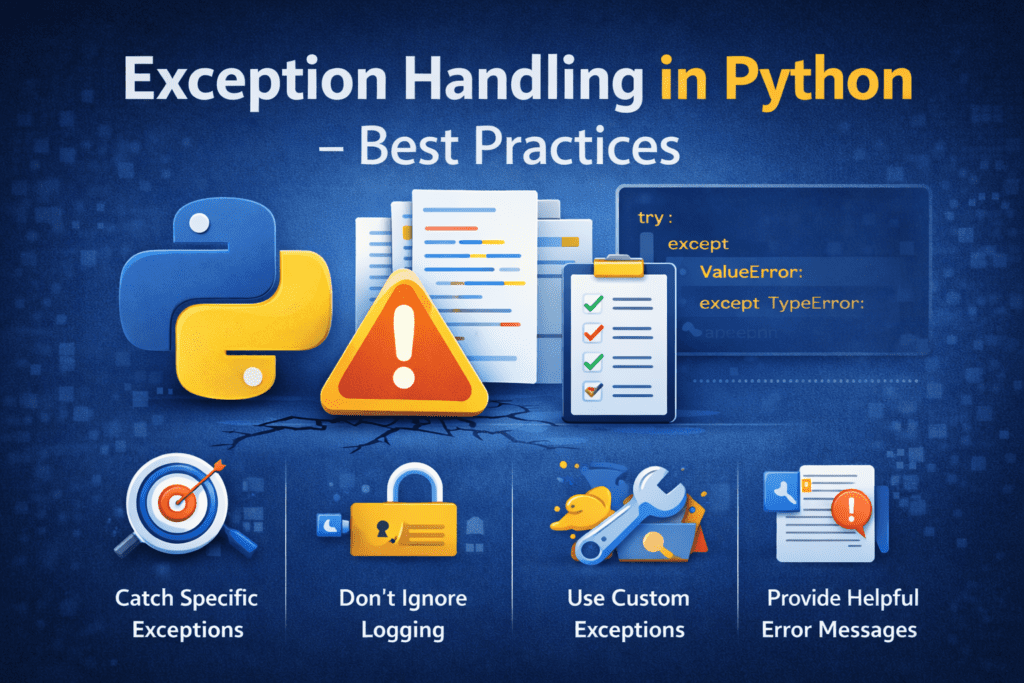
In software development, errors are inevitable. Whether caused by invalid user input, network issues, or unexpected program behavior, errors can disrupt the execution of an application. Exception handling in Python provides a structured way to manage these errors gracefully without crashing the program. By using proper exception handling techniques, developers can build more stable, secure, and user-friendly applications.
This article explains what exception handling is, why it is important, and the best practices developers should follow when working with exceptions in Python.
What is Exception Handling in Python?
Exception handling is a programming mechanism that allows developers to handle runtime errors during program execution. Instead of allowing a program to terminate abruptly, Python enables developers to detect errors and execute alternative logic.
In Python, exceptions are managed using the try, except, else, and finally blocks.
A simple example:
try:
number = int(input(“Enter a number: “))
result = 10 / number
print(result)
except ValueError:
print(“Please enter a valid number.”)
except ZeroDivisionError:
print(“Division by zero is not allowed.”)
In this example, Python catches specific errors and displays helpful messages instead of crashing the application.
Why Exception Handling is Important
Exception handling plays a crucial role in developing reliable software systems. It helps developers identify problems quickly and ensures that applications behave predictably even when errors occur.
Key benefits include:
- Preventing unexpected program crashes
- Improving application stability
- Providing meaningful error messages to users
- Making debugging and maintenance easier
- Enhancing the overall user experience
When implemented correctly, exception handling helps developers create robust and production-ready Python applications.
Best Practices for Exception Handling in Python
Following best practices ensures that exception handling improves code quality rather than complicating it. Below are some essential practices every Python developer should1. Catch Specific Exceptions
One of the most common mistakes is using a generic exception handler. Catching specific exceptions makes the code easier to understand and debug.
Bad practice:
except:
print(“Something went wrong”)
Better approach:
except ValueError:
print(“Invalid input”)
By specifying the exception type, developers can handle different errors more accurately.
2. Avoid Overusing Exception Handling
Exception handling should not replace normal program logic. Developers should only use exceptions for unexpected situations, not for controlling regular program flow.
For example, instead of relying on exceptions to check whether a file exists, it is often better to verify the file beforehand using proper conditions.
Overusing exceptions can make code harder to read and reduce performance.
3. Use the Finally Block for Cleanup
The finally block is executed regardless of whether an exception occurs or not. It is commonly used for resource cleanup tasks such as closing files, database connections, or network sockets. Example: try: file = open(“data.txt”, “r”) content = file.read() except FileNotFoundError: print(“File not found.”) finally: file.close() This ensures that resources are always released properly, preventing memory leaks or locked files.4. Use Custom Exceptions When Necessary
Python allows developers to create custom exception classes. This is useful when building large applications where specific errors need to be handled differently. Example: class InvalidAgeError(Exception): pass age = int(input(“Enter your age: “)) if age < 0: raise InvalidAgeError("Age cannot be negative.") Custom exceptions make code more meaningful and help maintain clarity in complex systems.[/et_pb_text][et_pb_text ol_item_indent="20px" _builder_version="4.27.6" _module_preset="default" ol_font_size="18px" ol_line_height="1.4em" header_2_font="Abel|700|||||||" header_2_text_color="#666666" header_3_font="Abel|700|||||||" header_3_text_color="#666666" header_3_font_size="24px" custom_margin="||||false|false" custom_padding="||||false|false" hover_enabled="0" global_colors_info="{}" theme_builder_area="post_content" sticky_enabled="0"]5. Provide Helpful Error Messages
Error messages should help developers and users understand what went wrong. Instead of vague messages like “Error occurred”, provide descriptive information. Example: except FileNotFoundError: print(“The requested file could not be located. Please check the file path.”) Clear messages make troubleshooting faster and improve the overall usability of the application.6. Log Exceptions Instead of Ignoring Them
In professional applications, exceptions should be logged rather than silently ignored. Logging helps developers analyze problems later and track system behavior. Example: import logging try: result = 10 / 0 except ZeroDivisionError: logging.error(“Attempted division by zero.”) Logging is especially important in large-scale systems and production environments.7. Use the Else Block for Clean Code
Python provides an else block that runs when no exception occurs. This helps keep code organized and improves readability. Example: try: number = int(input(“Enter a number: “)) except ValueError: print(“Invalid input.”) else: print(“You entered:”, number) Using the else block ensures that success logic is clearly separated from error handling.Real-World Applications of Exception Handling
Exception handling is widely used in real-world Python applications. Some common use cases include:
- Web applications: Handling invalid requests and server errors
- Data processing systems: Managing corrupted or missing data
- Financial software: Preventing calculation errors
- File management systems: Handling missing or inaccessible files
- APIs and integrations: Managing network failures or timeouts
Proper exception handling ensures these systems continue functioning even when unexpected situations occur.
Conclusion
Exception handling is an essential part of Python programming that helps developers build reliable and resilient applications. By managing errors effectively, developers can prevent crashes, provide better user feedback, and maintain cleaner code structures.
Following best practices such as catching specific exceptions, using meaningful error messages, implementing logging, and leveraging custom exceptions can significantly improve the quality of a Python project.
As businesses increasingly rely on Python for web development, data science, and automation, mastering exception handling becomes even more important for delivering high-quality software solutions. Companies like Auxilium Technology emphasize the importance of robust coding practices and error management techniques to build scalable and dependable applications that meet modern business needs.